More Than a Racing Simulator: Lessons From Three Months in a Porsche Dealership

Updated: 59 minutes ago
What happens when you place a high-end racing simulator inside a premium automotive dealership?
It's a question we had the opportunity to explore firsthand when Vthrotl Simulators installed a custom-built motion racing simulator at Porsche Centre London in early 2025.
The idea was simple: give dealership visitors something memorable to experience while introducing them to the performance and excitement of Porsche's motorsport heritage.
What we learned over the following three months was that a racing simulator can offer considerably more than entertainment. But getting the most out of it requires the right technology, planning, and a shared understanding of what the experience is meant to accomplish.
An Opportunity to Try Something Different
As a relatively new business, Vthrotl was looking for ways to introduce our services to the local automotive community and build brand awareness. Following a conversation with one of our industry mentors, we began exploring the idea of placing a racing simulator inside a premium dealership for a trial period.
Porsche Centre London seemed like a natural fit. With Porsche's rich motorsport history and a showroom filled with remarkable performance cars, racing simulation offered an opportunity to bring some of that excitement to life. Consider a Porsche 911 GT3 sitting in the showroom in the middle of an Ontario winter. It's not exactly the ideal time to take it out for a spirited test drive, let alone experience what it's capable of on a racetrack. But what if a visitor could climb into a racing simulator and experience that same model virtually, pushing its limits on a famous circuit without leaving the dealership or taking any real-world risks?
We approached the dealership with a proposal: Vthrotl would supply, install, and maintain a custom-branded motion simulator valued at over $30,000 for a three-month trial, at no charge.
For the dealership, it would provide an additional experience for customers visiting the showroom or waiting for service. For Vthrotl, it was an opportunity to demonstrate our capabilities while learning how this type of installation could work in an active automotive retail environment.
We also envisioned opportunities for dealership promotions, customer events, and friendly hot-lapping competitions.

Designing an Experience, Not Just a Racing Game
One of our main priorities was making the simulator accessible to visitors without requiring a dedicated operator.
Rather than having someone manage a computer and racing software between sessions, we configured the simulator to operate as a self-service kiosk using a simple tablet interface.
Visitors entered their name and email address before choosing from three Porsche driving experiences:
Porsche Cayman GTS at Brands Hatch
Porsche 911 GT3 at Laguna Seca
Porsche 911 GT3-R at Canadian Tire Motorsport Park (Mosport)
Each combination offered a different driving challenge, from the more approachable Cayman to a dedicated Porsche race car.
Participants could also select their preferred difficulty, ranging from a beginner-friendly experience with driving assists and a racing line to a more demanding simulation with those aids disabled.
After a few brief instructional screens, the simulator automatically launched the selected experience. From there, all the participant needed to do was drive.
Each session ran for seven minutes, with lap times and driving telemetry recorded automatically. At the end, participants were shown their fastest lap and a QR code linking to an online leaderboard.
A follow-up email thanked them for visiting Porsche Centre London and provided links to their results and Vthrotl's website. Participants could even compare their driving telemetry against the fastest recorded lap to see where they were gaining or losing time.
Between driving sessions, the simulator automatically displayed a video loop featuring a custom Vthrotl/Porsche Centre London promotional video, simulator-specific instructional slides, and dealership content. We also incorporated automated startup and shutdown routines, ensuring the simulator was ready for use during dealership hours and powered down outside of them.
The goal was to make the entire experience as straightforward as possible for both visitors and dealership staff.

When Technology Meets the Real World
One of the more valuable lessons from the installation came from adapting a sophisticated racing simulator to operate as a fully automated, self-service experience.
Unlike a conventional simulator managed by an operator, our system relied on third-party venue management software to drive the entire experience, from participant registration and selecting driving scenarios to session timing, leaderboards, and automated communications.
While the concept worked well, the additional software introduced some challenges during the initial deployment, particularly around network connectivity.
The dealership's corporate network, with its security protocols and restrictions, wasn't ideally suited to the software's requirements. After troubleshooting the issue, we ultimately removed the simulator from the dealership's network entirely and installed our own dedicated 5G wireless router.
This provided an independent internet connection and resolved the networking issues, significantly improving the reliability of the kiosk operation.
For the vast majority of its three-month installation, the simulator operated as intended. When occasional software-related issues did arise, we were generally able to resolve them quickly through remote access or a brief onsite visit. The simulator was never unavailable for an entire day.
The experience also highlighted the importance of having a designated dealership contact who was reasonably tech-savvy and comfortable with high-end computer equipment.
They wouldn't need to become a racing simulation expert, but someone capable of performing basic troubleshooting, restarting equipment when necessary, and communicating technical issues effectively would make a considerable difference.
More complex issues would remain our responsibility, addressed remotely or onsite as required.
It's an operational arrangement we'd establish from the outset for any future long-term dealership installation.
Making a Racing Simulator Dealership Experience Work
Perhaps the biggest lesson had little to do with the simulator itself.
From the beginning, we envisioned more than an impressive racing game in the corner of a showroom. We wanted to create an experience that encouraged friendly competition, repeat participation, and a connection to Porsche's motorsport heritage.
Our original proposal included regular hot-lapping competitions, leaderboard challenges, promotional prizes, social media content, and opportunities to showcase dealership videos and featured vehicles through the simulator's idle display.
While the technology was in place to support these activities, almost all of the promotional opportunities weren't pursued during the installation.
Looking back, we may have envisioned something more ambitious than the dealership was looking for or willing to participate in.
We saw an opportunity to create an interactive experience that encouraged visitors to return and improve their lap times, while the dealership may have preferred a simpler showroom attraction requiring minimal involvement.
Neither approach is necessarily wrong.
A dealership's primary responsibility is selling and servicing vehicles, not operating racing simulators. We understood that, which is precisely why we designed the system to be largely self-service.
But we also saw the potential to do more, with activities that didn't necessarily require a significant commitment from dealership staff.
A periodic social media post, a small incentive for the fastest lap, or a salesperson encouraging a customer to try the experience could all help turn a casual attraction into something more engaging.
In hindsight, the bigger lesson wasn't that our approach was necessarily too ambitious. It was that we should have established a clearer understanding of what both parties wanted to accomplish before the installation began.
A racing simulator doesn't need an elaborate promotional program to be enjoyable. However, with a little planning and participation, it can offer considerably more than a single driving session.
A Glimpse of What Was Possible
Perhaps the most memorable part of the installation came near the end of the three-month trial.
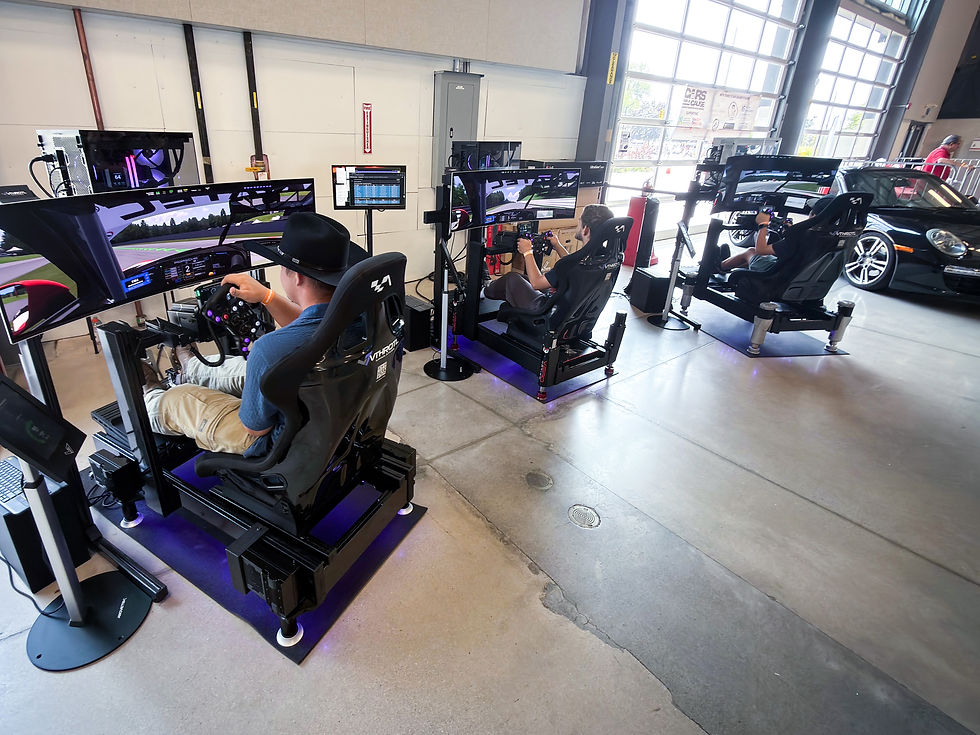
Porsche Centre London was hosting its first Cars and Coffee event of the season, and the dealership wanted the simulator available for attendees.
We were happy to accommodate.
When we arrived that morning, visitors were already using the simulator. It remained busy throughout the event and continued attracting participants for quite some time after the event had officially ended.

People were interested, engaged, and eager to have a turn.
For us, it was a particularly encouraging moment because it demonstrated what could happen when the simulator became part of a larger automotive experience.
Rather than simply occupying space in the showroom, it was giving visitors something to do, talk about, and share with others.
Following the event, the dealership expressed interest in having the simulator return for a future Cars and Coffee gathering.
Although other commitments prevented us from doing so, it was encouraging to see that level of interest.
What We'd Do Differently
Looking back, there are a few things we'd approach differently.
First, we'd establish clearer operational expectations before installation, including technical responsibilities, communication procedures, and a dedicated, technically capable dealership contact. Just as importantly, we'd make sure there was a good working relationship between everyone involved. A project like this doesn't require the dealership to share our enthusiasm for racing simulation, but it does benefit from open communication, mutual respect, and a willingness to explore opportunities together. When those elements are missing, even a promising idea can struggle to reach its potential.
Second, we'd work more closely with the dealership to determine what kind of experience it actually wants to offer.
For some dealerships, that might be a straightforward simulator customers can enjoy while waiting for service. For others, it could involve organized competitions, customer appreciation events, promotional campaigns, or driving challenges tied to particular vehicles.
Neither approach needs to be overly complicated, but each has different requirements.
Finally, we'd establish what success looks like before the installation begins.
Is the goal to entertain customers waiting for service? Encourage visitors to spend more time in the showroom? Support special events? Introduce younger audiences to the brand? Create opportunities for customer follow-up?
The technology can support these possibilities, but the experience should be designed around the dealership's goals rather than the other way around.
More Than a Showroom Attraction
Our three months at Porsche Centre London were a valuable learning experience for Vthrotl.
We gained firsthand experience operating a sophisticated racing simulator in a commercial environment, refining its automated operation, and understanding the practical realities of supporting it remotely.
We also saw genuine enthusiasm from dealership visitors and most of the staff, particularly when the simulator became part of an organized automotive event.
Perhaps the biggest takeaway is that a racing simulator can offer an automotive dealership something genuinely unique, but it takes more than installing the equipment to realize its full potential.
The dealership's job is to sell cars, not manage racing simulators. We understand that.
That's precisely why the experience needs to be designed to complement daily operations, with the right level of technical support and a clear understanding of what the dealership wants to achieve.
A racing simulator can be a fun addition to any showroom. But with a little creativity and planning, it can become something much more engaging.
And ultimately, another reason for customers to remember their visit.