Beyond the Hardware: What Goes Into a Custom Racing Simulator Build?

When you look at a completed racing simulator, or sim rig as it's often called, it's easy to focus on the hardware. The steering wheel, pedals, display, chassis, and the computer running everything.
But there's quite a bit more involved in putting together a complete high-end simulator than simply ordering the components and bolting everything together.
Every client build we do starts with a conversation about what the customer is looking for. From there, we work through the equipment options, assemble, configure and test the system, and eventually deliver it to their home.
A recent custom racing simulator build, assembled and tested at our London, Ontario studio before delivery to Southwestern Ontario, is a good example of how that process comes together.

It Started With a Demo
This particular project started with an inquiry about one of our Enthusiast Series simulators.
Our simulator series give us a starting point for each build. From there, we can make adjustments or add options depending on what the customer is looking for.
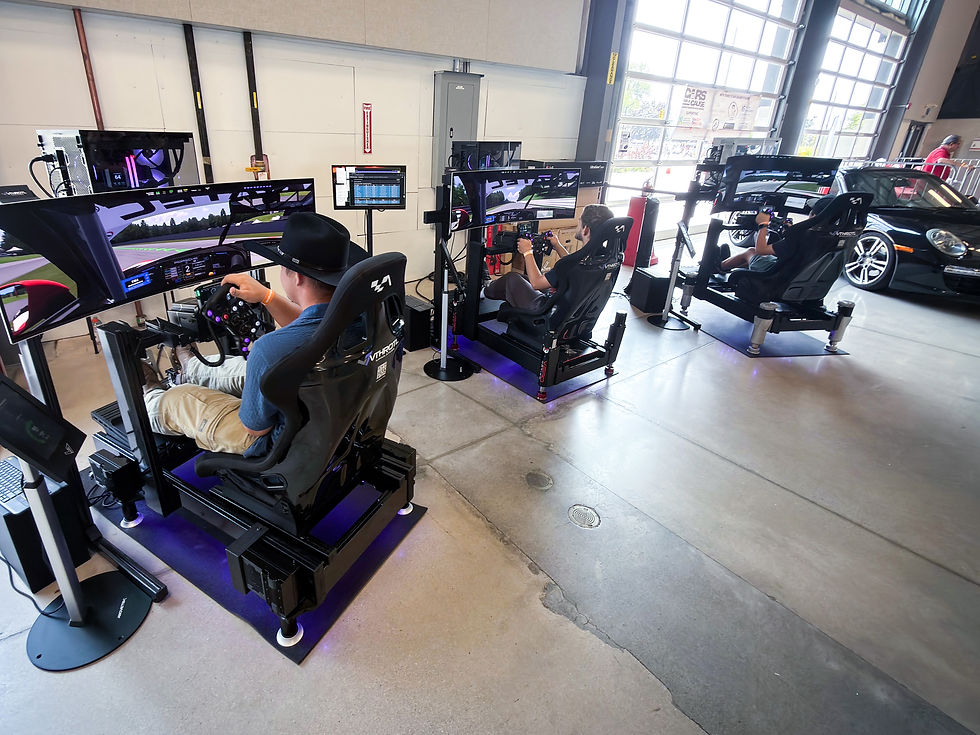
After preparing an initial estimate, we invited the client to visit our London studio to try some of the equipment. He brought a few friends along, and everyone had an opportunity to experience different simulator configurations, including motion systems.
They seemed to enjoy themselves, and we had a good conversation about the various options.
The project didn't move forward right away, but some time later, the client got back in touch and we picked up where we'd left off.
By then, some newer hardware had become available, and his budget had changed a little too.
We arranged another demonstration, tried the equipment again, and spent more time discussing what he wanted from his simulator.

Working Through the Options
There's only so much you can learn from reading specifications and watching reviews. Being able to try different equipment in person makes those decisions a little easier.
Despite enjoying the motion simulators, the client wasn't convinced he needed motion for his own setup. He did, however, want some physical feedback beyond what he'd feel through the steering wheel.
We discussed a few options and eventually settled on a Trak Racer bass shaker system, along with Simagic Reactor pedal haptics fitted to the Heusinkveld Sprint pedals. This would give him additional feedback through the chassis and pedals without the need for a full motion system.
The monitor was another consideration. He wasn't interested in triple screens initially, so we compared the Samsung 49-inch G9 OLED with the LG UltraGear 45-inch OLED. He preferred the LG.
He was also curious whether he could add triple screens down the road. The monitor stand can accommodate additional hardware addons, so expanding the setup later would be possible with two additional monitors.
He also wanted a clutch pedal and a shifter that could switch between H-pattern and sequential operation, so we selected the Simagic DS-8X to go alongside the Heusinkveld pedals.
For the steering wheel, he preferred something closer to a conventional road-car shape rather than a Formula-style wheel. I suggested the Gomez Sim Industries GT-MAX32, which also has its own integrated display. Although it was a more expensive option, it eliminated the need for a separate dashboard display unit.

With the Simucube 3 Pro having recently become available, we decided to incorporate the newer wheelbase into the build.
Even the seat was something we worked through. He'd tried a few different options during his visits and preferred the OMP seat.
By the time we'd finished discussing everything, we had a pretty good idea of what he wanted and which components made the most sense for his setup.
Inside a Custom Racing Simulator Build
Once the equipment arrived, we could get started on the assembly.
There's something satisfying about watching a collection of boxes gradually turn into a racing simulator. But putting the hardware together is only part of the job.

One of the more time-consuming parts of putting together a complete sim racing setup is preparing the computer and configuring all the software.
That includes setting up accounts, installing the racing titles and supporting applications, configuring graphics and steering feedback, calibrating pedals, mapping controls, and making sure the various components communicate properly.
And then there's testing. Lots of testing.
Each racing title has its own quirks and settings, so getting everything working properly across multiple games takes time. The haptic feedback components also need to be configured and adjusted.
Cable management is another part of the process that can take considerably longer than you might expect.
Between the wheelbase, pedals, shifter, display, audio equipment, haptic feedback system, and various USB connections, there's a fair amount of wiring to organize. We try to keep everything as neat as possible while making sure connections remain secure and accessible if something needs attention later.
It's not particularly glamorous work, but it makes a difference to the finished installation.

Once everything is assembled and configured, we run through the installed racing titles and equipment again to check that everything is behaving as expected before preparing the simulator for delivery.
From Our Studio to His Home
With the simulator ready, we loaded everything up and headed to the client's home in Southwestern Ontario.

The installation itself was straightforward. He'd already planned out where the simulator would go, so once everything was in place, we only needed to make a few minor adjustments to the seating position.
From there, we spent a couple of hours going through how to use the system.
That included startup and shutdown procedures, launching the different racing titles, selecting cars and tracks, getting familiar with the controls, and answering questions along the way.
We also prepare personalized documentation for each complete simulator build, including a quick-start guide, operating instructions, and basic troubleshooting information. The client receives both printed copies and PDFs to refer to afterward in addition to a small toolkit.
Of course, there's only so much you can cover in a couple of hours, and it's difficult to remember everything when you're learning a new system.
That's where post-delivery assistance comes in. We can connect remotely when needed to help with software questions, configuration changes, or troubleshooting. We can also provide assistance by email or phone.
The last thing we want is for someone to run into a problem and feel they're stuck trying to figure it out on their own.
The Part You Don't Always See
When everything is finished, most of the work that went into the simulator isn't particularly obvious.
You see the completed chassis, the display, PC, steering wheel, and pedals. What you don't necessarily see are the hours spent working through equipment choices, organizing cables, configuring software, testing different settings, and preparing everything for delivery.
There's no shortage of excellent sim racing hardware available today, and plenty of people enjoy building and configuring their own systems.
But not everyone has the technical knowledge, practical skills, or interest in taking on that process, particularly when you're dealing with equipment from several different manufacturers and multiple racing titles. Not to mention the amount of time involved.
For this client, we were able to work through the options together, assemble and configure everything at our studio, and deliver a complete simulator ready to use.
It's a good example of how much actually goes into a complete racing simulator beyond the hardware itself.